
Abatement Technologies Air Duct Cleaning in San Antonio: A Homeowner’s Guide
Abatement Technologies air duct cleaning in San Antonio uses HEPA-rated negative air machines that capture 99.97% of particles down to 0.3 microns—far exceeding what portable shop vacuums or consumer-grade extractors can achieve. For homeowners dealing with San Antonio’s cedar pollen, mold spores, and construction dust, this equipment level determines whether your ducts actually get cleaned or simply get stirred around. If you’d rather not sort through contractor claims yourself, call us at (866) 769-1699 for a free estimate and we’ll show you exactly what we’re running.
Most homeowners have never heard of Abatement Technologies, which is exactly why contractors who invest in professional-grade equipment should explain what they’re using and why it produces different outcomes than the portable units loaded into a generic service van. We’ve been in enough San Antonio attics and crawlspaces over 17 years to know that the machine sitting on the truck matters as much as the person running it.
What Abatement Technologies Equipment Actually Is
Abatement Technologies manufactures HEPA-rated negative air machines and containment systems built for professional remediation, industrial maintenance, and medical-grade air quality projects. These aren’t rebranded shop vacuums with fancy labels—they’re engineered systems designed to create controlled negative pressure environments while filtering exhaust air to HEPA standards.
The core units used in duct cleaning applications, like the Predator and HEPA-AIRE series, pull 1,000–2,000 CFM (cubic feet per minute) through multi-stage filtration including a primary filter, secondary filter, and certified HEPA final filter. That airflow volume matters because duct systems in San Antonio homes—especially the larger ranch-style and two-story builds common in neighborhoods like Alamo Heights and Stone Oak—need sustained negative pressure to prevent debris from escaping into living spaces during agitation.
Here’s what separates genuine Abatement Technologies equipment from consumer-grade alternatives:
- Certified HEPA filtration: Third-party tested to 99.97% efficiency at 0.3 microns, not “HEPA-type” or “HEPA-like” marketing language
- Negative pressure containment: Creates suction that pulls dislodged debris toward the filter, not toward your furniture
- Sealed cabinet construction: Gasketed doors and pressure-tested housings prevent bypass—unfiltered air doesn’t leak out the sides
- Variable speed control: Allows technicians to match airflow to duct system size, critical for older San Antonio homes with galvanized or flex duct
We’ve run Rotobrush and Nikro agitation tools alongside Abatement Technologies negative air machines on hundreds of San Antonio jobs. The agitation breaks debris loose; the Abatement machine captures it before it resettles. One without the other is incomplete.
Why HEPA Filtration at 0.3 Microns Matters for San Antonio
The 0.3 micron specification isn’t arbitrary—it’s the Most Penetrating Particle Size (MPPS), the point where filtration is hardest because particles are small enough to follow airflow around fibers but large enough to have inertia. Capture efficiency at 0.3 microns proves the filter works across the entire particle range.
San Antonio’s specific allergen profile makes this critical:
- Cedar pollen: 20–30 microns—easily captured, but present in extreme seasonal concentrations that overwhelm lesser filters
- Mold spores (Aspergillus, Penicillium): 2–10 microns—common in humid crawlspaces and after water damage
- Dust mite debris: 10–40 microns, but the allergenic proteins attach to smaller carrier particles
- Combustion particulates: Under 2.5 microns—from gas appliances, wildfire drift, and vehicle exhaust in urban San Antonio corridors
We serviced a home near McAllister Park last spring where the homeowner had persistent allergy symptoms despite regular filter changes. The previous “duct cleaning”—done with a portable unit from a national franchise—had stirred decades of accumulated debris without proper containment. We set up Abatement Technologies negative air, ran Rotobrush agitation through the entire trunk line, and the HEPA filter loaded with fine particulate that would have redeposited throughout the house. That’s the difference equipment makes.
How Negative Air Prevents Cross-Contamination
Here’s what happens during duct cleaning without professional containment: agitation tools knock debris loose, the HVAC blower or natural air movement carries it through open vents, and your living room becomes the final filter. We’ve seen it—white couches in Terrell Hills homes coated in black soot because someone ran a brush without proper suction.
Professional negative air setup creates this controlled sequence:
- Access point creation: Technician cuts a sealed access into the main trunk line
- Negative air connection: Abatement Technologies machine attaches and begins pulling 1,000+ CFM
- Zone isolation: Supply and return registers are sealed or selectively opened to control airflow path
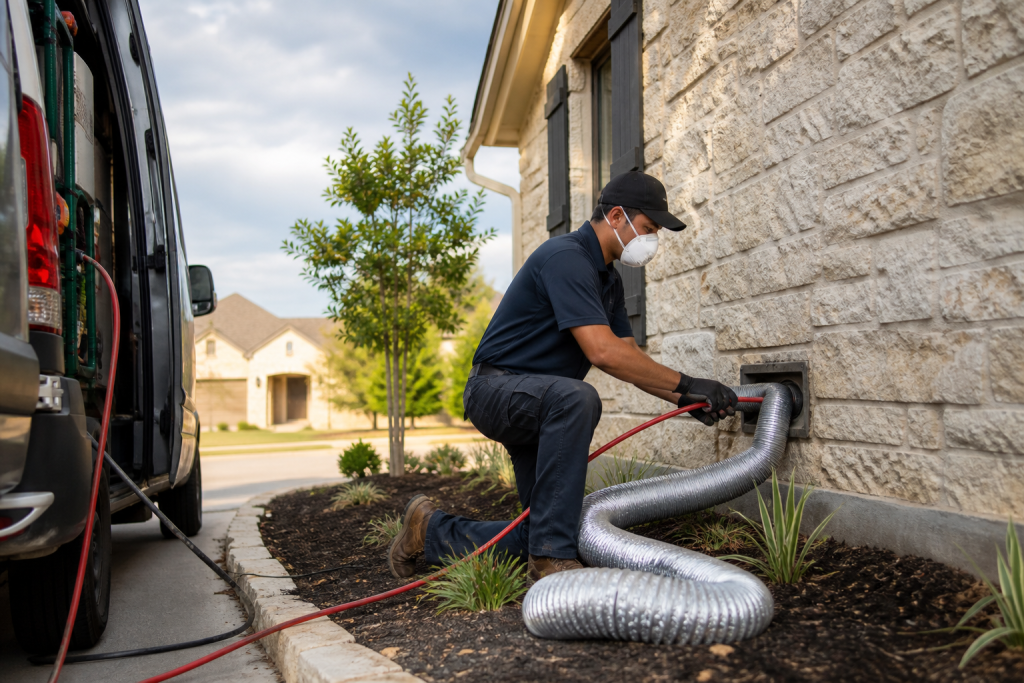
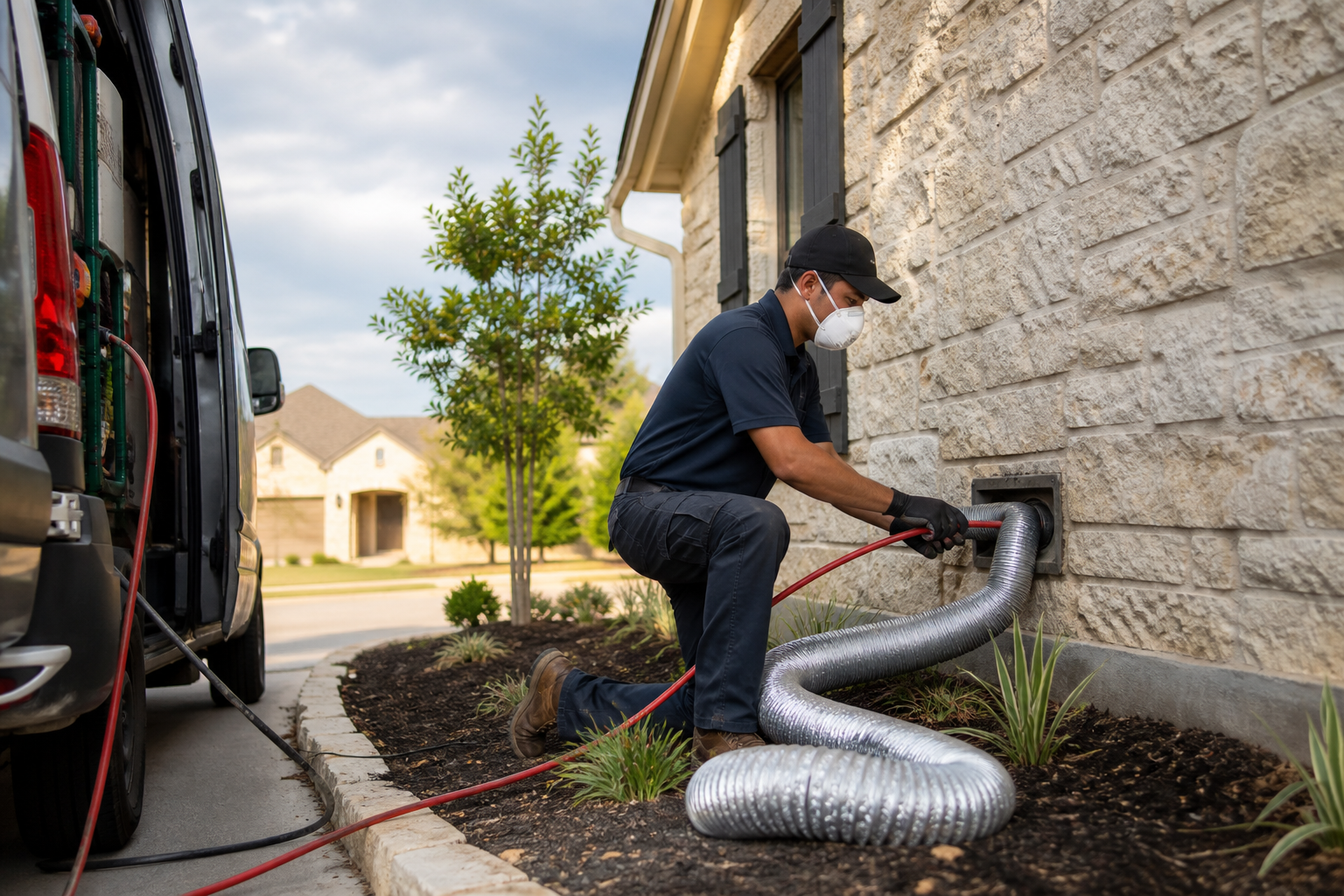
- Agitation: Rotobrush or Nikro tools dislodge debris, which is immediately drawn toward the negative air machine
- HEPA exhaust: Filtered air exits the machine; captured debris stays in the replaceable filter bank
The containment isn’t passive—it’s engineered. The negative pressure differential means air flows into the duct system, not out of it. Without this, you’re paying someone to redistribute your dust.
Equipment Investment as a Contractor Signal
A single Abatement Technologies HEPA-AIRE portable negative air machine runs $3,500–$6,000 depending on capacity and filtration package. The replacement HEPA filters alone cost $200–$400 per changeout. Compare that to a $300 wet/dry vacuum from a hardware store with a “HEPA” bag attached.
This cost barrier separates operators who bought real tools from those who didn’t. When we quote a job in San Antonio, we’re pricing for equipment that costs more than some competitors’ entire van setup. That’s not elitism—it’s the only way to achieve the containment and filtration standard that actual duct cleaning requires.
Questions to ask any contractor before booking:
- “What specific negative air machine do you use, and what’s its rated CFM?” (Vague answers or “we have a HEPA vacuum” are red flags)
- “Is your HEPA filter third-party tested, and do you have the certification documentation?”
- “How do you prevent debris from escaping during agitation?” (They should describe zone isolation and negative pressure, not just “we’re careful”)
- “What happens to the debris after capture—where does your machine exhaust?” (Should be HEPA-filtered exhaust, not unfiltered discharge into your garage or attic)
When the owner shows up, so does 17 years of hands-on experience. At Liberty Bell Air Duct Cleaning Service San Antonio home, Richard Anderson operates the equipment on every job—not a rotating crew learning on your system.
When to Call a Professional in San Antonio
DIY duct inspection is reasonable: remove a vent cover, shine a flashlight, photograph visible debris. But actual cleaning with proper containment requires equipment most homeowners won’t purchase or maintain. Call a professional when you notice persistent dust accumulation after cleaning, musty odors when the HVAC cycles, visible mold, or allergy symptoms that worsen at home. In San Antonio’s climate, humidity and pollen create conditions where deferred maintenance accelerates air quality problems.
Related services in San Antonio: We also provide Air Duct Cleaning in Lackland Air Force Base, Dryer Vent Cleaning in Lackland Air Force Base, and HVAC Cleaning in Lackland Air Force Base for homeowners in that service area.
The Bottom Line
Abatement Technologies equipment represents a specific tier of professional capability: certified HEPA negative air machines that prevent cross-contamination during duct cleaning, not portable units that redistribute debris. For San Antonio homeowners, the local allergen load—cedar, mold, fine dust—makes proper filtration and containment essential, not optional. The contractor’s equipment investment is one of the most reliable signals of whether you’ll get actual cleaning or equipment theater.
Key takeaways:
- True HEPA means 99.97% at 0.3 microns, certified—not “HEPA-type”
- Negative air machines create suction that captures debris during agitation; without them, debris escapes into your home
- Equipment cost separates professional operators from those running inadequate tools
- Always ask specific questions about CFM, filter certification, and containment protocol
- San Antonio’s climate and allergen profile make proper equipment especially critical
If you’re in San Antonio and want to know exactly what equipment will be used in your home, Liberty Bell Air Duct Cleaning Service San Antonio offers free estimates—call (866) 769-1699. We’ll walk you through our setup before we start.
Frequently Asked Questions
Yes—Abatement Technologies machines are engineered for negative pressure containment at professional airflow volumes (1,000–2,000 CFM), while consumer HEPA vacuums lack the sealed cabinets, variable speed control, and CFM capacity needed for duct system isolation. A standard HEPA vacuum can filter what it directly sucks up; it cannot create the negative pressure environment that prevents debris from escaping during agitation. Call (866) 769-1699 if you’d like to see how our setup works before booking.
Professional duct cleaning with certified HEPA negative air machines in San Antonio typically ranges from $400–$900 for a standard single-system home, depending on duct complexity, accessibility, and contamination level. Homes with multiple HVAC zones, extensive flex duct, or remediation needs (mold, post-construction) run higher. The equipment investment we described is one factor in that pricing—contractors running genuine Abatement Technologies or equivalent systems can’t match the bottom-dollar quotes from operators using inadequate tools. Call (866) 769-1699 for an exact quote; estimates are free.
You can remove surface debris from accessible vent covers and short duct runs, but you cannot achieve proper containment or reach the full trunk line and return plenum where most accumulation occurs. Without negative air isolation, agitation releases fine particulate into your living space. We don’t recommend DIY duct cleaning for the main system—it’s genuinely ineffective and can worsen air quality. For the full pathway cleaning that changes measurable outcomes, professional equipment and containment are necessary.
Ask to see the machine on arrival—genuine Abatement Technologies units have serial-numbered HEPA certification labels and distinctive cabinet construction. Request documentation of filter certification, and observe whether they set up negative air isolation before agitation begins. A legitimate operator will explain their containment protocol without defensiveness. At Liberty Bell, we walk San Antonio homeowners through our equipment setup as standard practice—professional equipment is something we’re proud to show, not hide.
Written by Richard Anderson, Owner & Lead Technician at Liberty Bell Air Duct Cleaning Service San Antonio, serving San Antonio since 2009.
Need Air Duct Cleaning Help?
Call Liberty Bell Air Duct Cleaning Service San Antonio — licensed & insured, here with fast after-hours help in San Antonio.
(866) 769-1699